
Fields in Neosho County Property Tax Records
The CIC tax module handles both current tax and tax history. A full record gathers property type, tax year, account identifiers, name role, statement status, and payment facts in one place.
| Field | What it means | Custodian |
|---|---|---|
| Property type and year | Real Estate and the exact tax year frame the result | Treasurer portal |
| Owner or taxpayer mode | Current Owner, Taxpayer, or Both states the searched role | Treasurer portal |
| Account clue | CAMA, Quick Ref, tax unit, parcel, address, or owner ID | CIC systems |
| Assessment | Appraised and assessed values should remain separate | Appraiser |
| Statement status | Due, paid, or delinquent with a year and check date | Treasurer |
Special assessments and levies sit with the County Clerk. The Treasurer handles collection and distribution. Remember, a tax bill is not a record of sale value.
Search Fields for Neosho County Property Tax
The CIC Tax Information Module splits Real Estate from everything else. Personal Property, Oil, Gas, Trucks, Minerals, and State Assessed Utilities sit in a separate group. Query options run from CAMA segments to parcel. You can also search by owner ID, tax unit, Quick Ref, street, subdivision, block, lot, section, township, range, and lease name. Name searches can target Current Owner, Taxpayer, or Both. Status controls narrow results to current taxes. You can also pull statements with current or delinquent taxes due.
Keep any leading zeroes in CAMA fields. Write down each control you select. A blank narrow result does not rule out tax history. The official Neosho County tax search shows all of these controls on one screen.
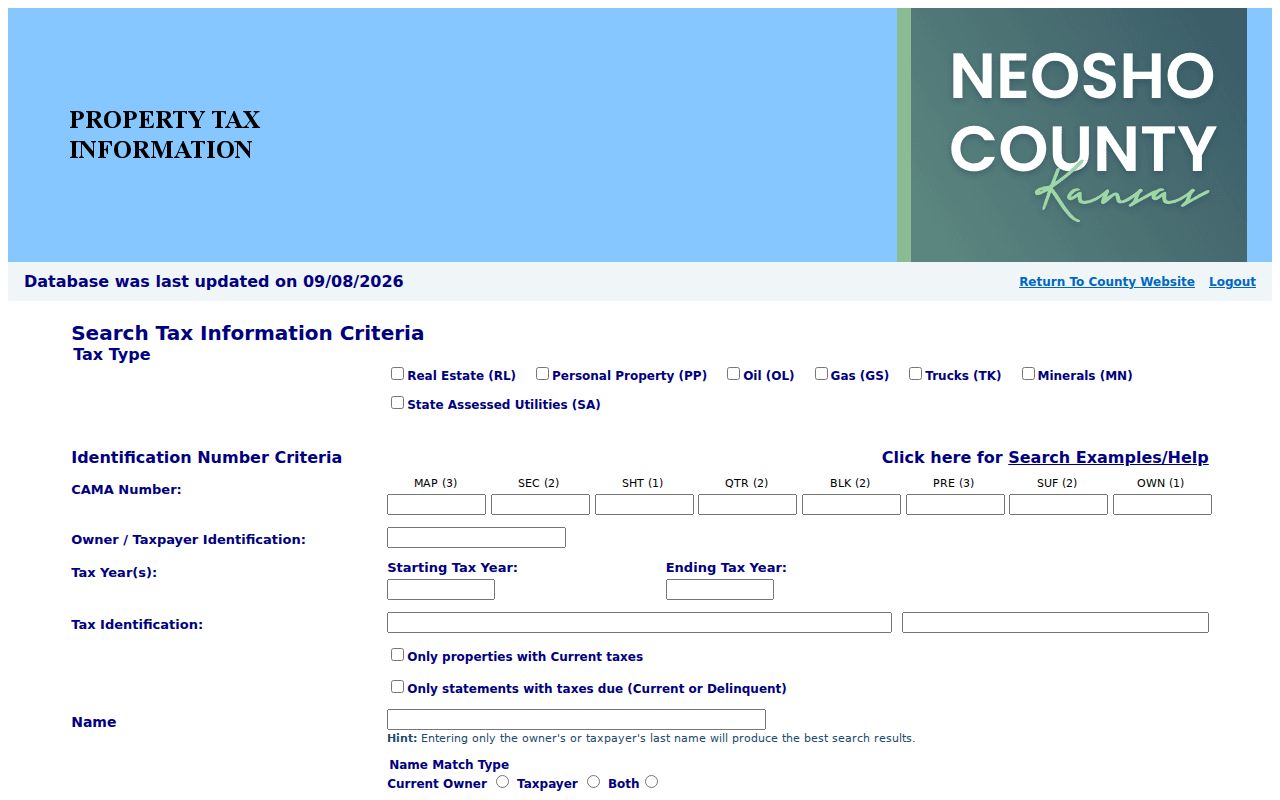
The form lets a reader repeat a property tax records query with its balance, year, type, and name role still tied together. That context is what makes the result trustworthy.
Look Up a Neosho County Tax Bill
Start in Real Estate with a Quick Ref, CAMA number, address, or owner. Set the tax year. Pick the name role. Then decide whether you want general history, current taxes, or only statements with taxes due.
- Select the correct property type and enter one strong identifier.
- Record the tax year and Current Owner, Taxpayer, or Both mode.
- Capture tax due, payment date, delinquency, interest, and cost only when displayed.
- Confirm the statement and payment route with the Treasurer.
- Assessed value
- The class-adjusted base to which levies apply.
- Mill levy
- The local rate applied to assessed value.
- Taxpayer
- The billed party, which may differ from deed ownership.
- Tax lien
- A claim arising from unpaid tax, subject to official status checks.
Neosho County Property Tax Calendar
First-half taxes are due December 20, per the Treasurer. Second-half taxes are due May 10. The original statement carries two stubs, and no second-half statement is mailed. Keep that statement, or revisit the portal before May.
Mail payments to P.O. Box 176, Erie, KS 66733. The Treasurer's office sits at 100 South Main, Room 101, and answers at 620-244-3800. Ask the office for a delinquent total and current payment instructions. Online payment needs the tax statement according to the county page, so pair the portal with a phone call when the bill is missing.
Kansas Ratios Behind Neosho County Property Tax
Kansas applies class ratios before local levies. Residential property is assessed at 11.5 percent of appraised value. Commercial and industrial property uses 25 percent, vacant lots 12 percent, utilities 33 percent, and agricultural improvements 25 percent. Agricultural land is assessed at 30 percent of use value.
KDOR gives a plain example. A $100,000 residential appraisal becomes $11,500 assessed. The same commercial appraisal becomes $25,000 assessed. Taxing units then apply their levies to that figure.
Four different figures. Sale price, appraised or use value, assessed value, and property tax due answer separate questions.
Delinquent Neosho County Property Tax Records
A portal filter can flag statements with current or delinquent tax due. Only the Treasurer can confirm a live balance. The office also confirms the redemption state. The county's 2024 bidder sheet warned that an owner could redeem before sale. It also noted the county offered no abstract, title evidence, or title insurance.
That sale date is history, not a schedule. Check the current Treasurer notice, legal publication, and court file. Also check any recorded sheriff's deed or release for the year you need. Kansas law requires newspaper publication once weekly. It must run for three straight weeks before a sale.
Appeal a Neosho County Assessment
Value notices go out March 1 under the Kansas calendar. K.S.A. 79-1448 allows 30 days from mailing to request informal review. Save the notice and envelope. Keep the parcel number, comparable sales, and condition facts handy too. Photos, measurements, permits, and correspondence also help. Informal meetings generally happen by May 15, with determinations by May 20. A Board of Tax Appeals filing then follows within 30 days of that decision. Verify current forms and instructions with the Appraiser.
Appeal window. Count from the mailed notice and confirm the current Neosho County procedure before the 30-day period expires.
Separate the Four Numbers in a Neosho County Tax File
Four different numbers live in a Neosho County tax file. A recorded sale price is one figure. An appraised or agricultural use value is another. An assessed value and the tax due each answer a separate question as well. Sale consideration may reflect a family transfer, entity change, partial interest, or stated exemption. It may not reflect a market deal. Appraised value is the county's estimate. Agricultural land may use productivity-based use value instead. Assessed value applies the Kansas class ratio.
Tax due starts from assessed value. But levies, credits, exemptions, special assessments, interest, and costs all move the total. Do not rebuild a tax bill from appraised value alone. Record each figure with its year, source, and property class. Then confirm the live balance with the Treasurer.
Research a Neosho County Tax Sale Carefully
A prior bidder sheet is historical, never a current tract list or sale date. The owner may redeem before the sale. The county supplies no abstract, title evidence, or title insurance. Confirm the current Treasurer notice and newspaper publication. Check the court case, redemption status, and legal description. Also verify any recorded sheriff's deed or release.
Search Register of Deeds records for mortgages, liens, releases, and easements. Look for oil and gas interests and lis pendens there too. Search the court file for foreclosure, quiet title, probate, or other claims. A blank portal result is not a clearance certificate. Prospective bidders should get legal advice before relying on a tax record.
Use Every Neosho County Property Tax Access Route
Speed comes from the CIC module. Authority does not. The Treasurer alone controls statements, payment status, delinquency figures, and current payoff amounts, so that office is the real destination for anything touching an actual Neosho County tax bill. Walk into 100 South Main, Room 101, in Erie, call 620-244-3800, or mail P.O. Box 176, Erie, KS 66733. When you ask, be specific: name the tax year, the property type, and the Quick Reference, and request the balance plus the payment routes the office accepts.
Questions about value belong elsewhere. The Appraiser, at Suite 14 and 620-244-3821, handles classification and appraisal matters for Neosho County parcels. The County Clerk keeps levy and special-assessment context. If a file never made it online, send a focused Kansas Open Records Act request to whichever office actually holds it, instead of asking one custodian for every record tied to a parcel number.
A missing tax statement is not a reason to guess. Never estimate an account or payment amount from an appraisal card. Search the CIC module first. Record the Real Estate selection, the year, the name mode, the parcel keys, and the filters. Then ask the Treasurer to confirm the live account. A blank taxes-due query can simply mean no balance sits under those filters. It does not mean no historical statement exists. The Current Owner, Taxpayer, and Both settings are deliberate choices. A taxpayer may be a billed party rather than the deed holder. Mineral, oil, gas, personal-property, and utility accounts can sit apart from real estate. Label the role and property type in every result you keep.
Assessment notices run on their own calendar. County value notices go out around March 1 under the Kansas schedule. The day you open the CIC is only an access date, nothing more. Retain the envelope and the notice, because the 30-day informal-review window is calculated from the mailing date. Reinspection is context, not a final tax outcome. The 2025 notice described measurements, front and back photographs, attempted contact, and questionnaires in named corridors. It did not claim every parcel was inspected or that a displayed value changed on a fixed date. Ask the Appraiser for the parcel's valuation and review record. A focused tax-record note should retain the portal URL and update date, the query date, the property-type box, the CAMA or Quick Reference, the owner role, the street or subdivision fields, the year range, and the status filter. The result then records the tax year, the current or delinquent status, the taxpayer, the amount, the payment, the interest, and any costs only when shown. For exemptions, disaster relief, or Neighborhood Revitalization, ask for the parcel's actual application and decision. General program criteria do not prove that a named property qualified. The county describes a substantial-destruction threshold, and Chanute describes investment criteria. But eligibility, dates, value increase, and rebate schedule need current custodian confirmation. Keep the approval, the tax year, the affected value, and the later statement together. That way a program benefit is never confused with a permanent change in title or classification.