
Read the Neosho County Current Owner Record
The CIC Parcel Search shows the assessment roll's Owner name field directly. Keep the label exact, and save the parcel keys, legal description, address, and check date alongside it.
| Owner name | The current roll label |
|---|---|
| Property # / Quick Reference | Cross-office parcel keys |
| Mailing address | Where notices may be sent |
| Full address | The situs, or property location |
| Legal description | The deed-matching description |
| Source date | Portal update and check date |
The owner of record shown in Neosho County property records may not live on the parcel. Someone else often does. The CIC portal displayed an update stamp of 4:49 a.m. on September 8, 2026, yet a single stamp cannot date every deed behind the tax roll. A deed recorded later may still be sitting in the pipeline. View the official CIC fields behind the current-owner record.
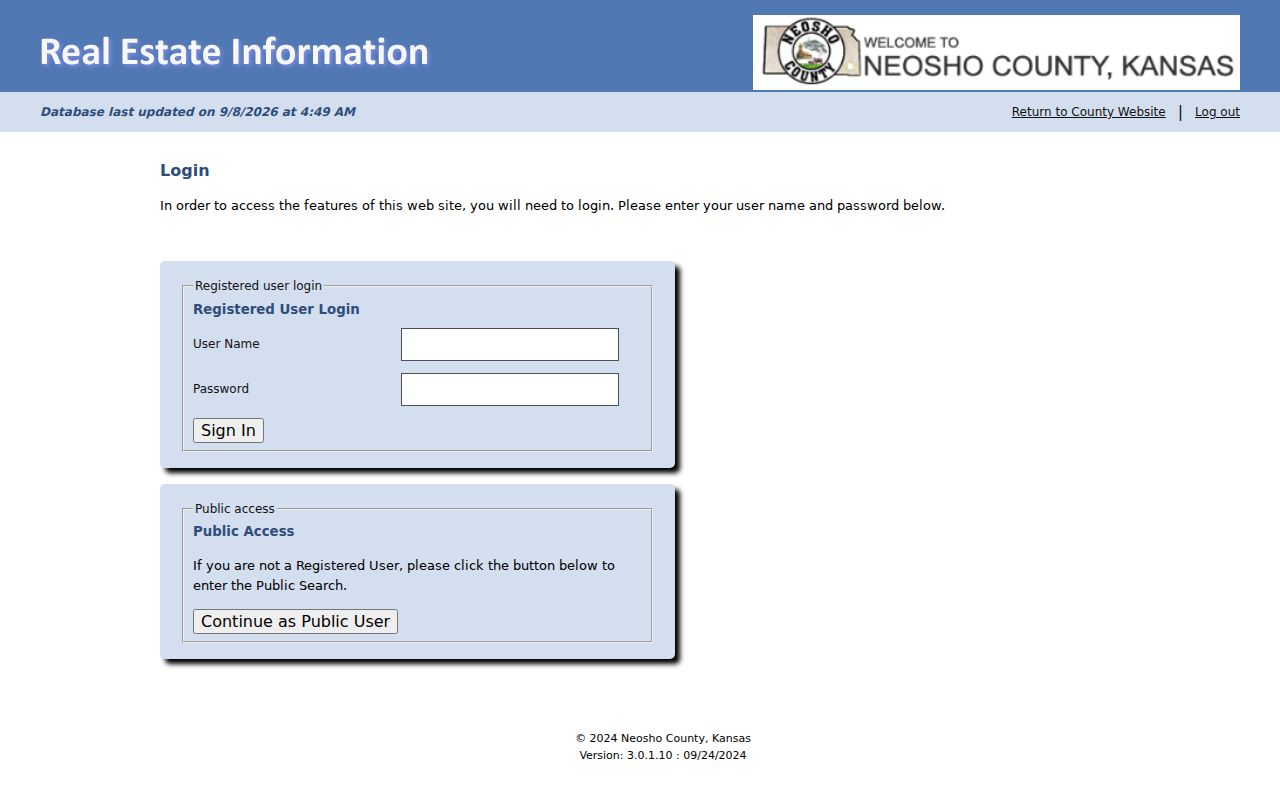
The form keeps things tidy in one Neosho County property search.
Date a Neosho County Current Owner Check
The Appraiser revises values continually. Permit checks, reinspections, field measurements, and photographs all feed the roll, but no rule promises a set interval between a recorded deed and the next appraisal update. So log the portal timestamp, your search date, the deed recording date, and the tax year as four separate facts. A fresh deed can easily precede its assessment update.
Freshness rule. “Current owner” is meaningful only when the source field and date are named.
Separate Owner and Taxpayer Roles
The CIC Tax Information Module lets you pull Current Owner, Taxpayer, or Both. The billed party is not always the deed owner. Note the role you chose, the property type, and the tax year. Then confirm against the conveyance in the deed records. Real Estate covers land and buildings. Oil, gas, minerals, personal property, trucks, and state-assessed utilities can show up separately. Each may appear as its own parcel record in the same Neosho County tax roll.
Confirm the Neosho County Current Owner by Deed
The Register of Deeds files qualified instruments under both owner names and legal descriptions. Pull every deed that matches the parcel you are checking. The most recent conveyance settles the question of who holds title now.
- Record CIC's Owner name, Property Number, Quick Reference, and legal description.
- Request the newest deed indexed to that owner and land description.
- Compare the grantee, recording date, instrument or book/page, and prior reference.
- Preserve trust, estate, corporation, trustee, or executor vesting exactly as recorded.
- Owner of record
- The party named on the assessment roll on a stated date.
- Vesting
- How a deed places rights in a person or entity.
- Grantee
- The party receiving an interest.
Use the Erie Records Counter When Names Conflict
The records counter in Erie handles public inspection Monday through Friday, 8:00 a.m. to 4:30 p.m. Kathy Milner takes questions at 620-244-3858 or registerofdeeds@neoshocountyks.org. Mailed requests go to P.O. Box 138, Erie, KS 66733. Copies and certification may carry fees.
The Register of Deeds publishes no online grantor-grantee index, and no earliest online year applies. Phone, mail, email, and in-person requests are therefore the working routes into Neosho County deed records.
Keep Trust and Company Ownership Intact
The owner of record in Neosho County is not always a person. A trust, corporation, estate, trustee, or executor may hold title. Search each name form with care. Try initials and reversed surname order. Try former names too. Also try the exact entity form the deed records use.
Powers of attorney and corporation records can clarify who holds signing authority. Never swap an entity for a person. Do not rely only on a mailing address in the property records.
Monitor Neosho County Recordings in 2026
Neosho County offers a free land-fraud notification service that began January 1, 2026. Subscribe and it emails you whenever a document is recorded in a subscribed name. Submit every likely name variant. Use one form per person and per email, by mail or in person.
An alert does not block a filing or prove fraud. Always verify the instrument with the Register of Deeds before acting on it.
Compare the Mailing and Situs Addresses
The situs address and the mailing address serve different jobs. One pins down where the parcel sits. The other tells the county where tax notices and correspondence go. The two often diverge. An entity may hold title. The owner may live out of state. A rural route may carry the mail, or a fiduciary may receive the paperwork. Keep both fields intact, and never treat a mailing address as evidence of residence.
When an address search fails in CIC, broaden the attempt. Try Full Address first. Then use the separate controls for street number, direction, name, suffix, and postal code. Remember that a postal city only reflects mail delivery, not the legal city limits. Before trusting any current owner name, confirm the match with the parcel number, Quick Reference, tax unit, and legal description.
Check Current Title Disputes by Party Name
Owner records can clash for a reason. A pending lis pendens, a foreclosure, a quiet-title action, a partition, probate, or a lien fight may all explain the disagreement. Look up the parties through the Kansas CaseSearch portal by name or case number. Then use the courthouse terminal for filings that never reach the web. The Neosho District Court sits at 100 S Main Street, Room 110, in Erie. It also sits at 102 S Lincoln Street in Chanute. Portal data never equals the full official file. Keep the case number, parties, filing date, disposition, and document availability, and order a certified copy when you need proof.
State a Current Owner Finding Precisely
Precision matters when you report a current owner. A cautious note states a simple fact. CIC showed a named party in its Owner field on a stated date. A stronger deed note goes further. It names the recorded instrument, grantor, grantee, recording date, and legal description. Neither version claims the title is clear. A tax note should likewise say whether the name appeared as Current Owner or Taxpayer. That distinction keeps a billing role from hardening into an unproven ownership claim. It also lets anyone redo the search after the portal changes.
Resolve a Blank Current-Owner Result
A blank result is rarely final. Spelling errors, stale addresses, partial parcel numbers, expired portal sessions, or unindexed records all produce empty screens. Write down the exact query and date, then retry with owner name variants, component street fields, the Quick Reference, and the full legal description before you call the custodian.
Start with the parcel's legal identity, not just a name. Keep the situs address separate from the mailing address. Enter the Property # and Quick Reference # exactly as shown. Match the county card's legal-description clue against the recorder's full description. In a city, a subdivision name can narrow a property search. The dropdown entry is not a certified plat, though. Rural land is different: hold onto Section, Township, Range, acreage, and CAMA segments, leading zeroes included.
Freshness matters when a deed may be new. Track the deed recording date on its own line. Do the same for the CIC update time. Add the assessment or reinspection date, the tax year, and any permit or court date, each on its own line. Neosho County materials describe continual revision and fieldwork. They promise no fixed number of days from recording to tax roll refresh. A new deed can be valid while the older roll name still shows.
Use every official channel when the portals leave doubt. The Register of Deeds allows public inspection and takes precise phone, email, mail, or counter inquiries. The Appraiser can explain the roll field. The Treasurer can clarify the taxpayer role. A courthouse terminal may expose public case material that is not online. A focused KORA request can seek a defined county file. Narrow it by parcel, record type, date range, and format.
Keep the conclusion narrow. A strong note names the exact field, source, and date. Then it cites the recorded conveyance that supports or complicates it. A taxpayer, mailing contact, trust beneficiary, or company officer is not automatically the owner of record. The same goes for a person named in litigation. A deed, estate paper, court order, or entity instrument can have unclear legal effect. Qualified title or legal review is the next step then.
Contact a Neosho County Current Owner Lawfully
A public mailing address can support a purchase inquiry, an easement question, or a boundary matter. Address the exact displayed owner or entity. State the property purpose plainly. Never assume the mailing location is the owner's home.
Lawful use. Use Neosho County current-owner data only for legitimate property research. Never use it to watch, harass, intimidate, or harm anyone.
A lookup is not a title opinion. For the broad route, use the owner-finding method, or turn to former owner records to trace the chain backward.